

blogs
PM Surya Sarovar Yojana: India's ₹5,070 Crore Bet on Floating Solar, Explained
3 Aug 2026 • SLNKO Research Desk • 7 min read
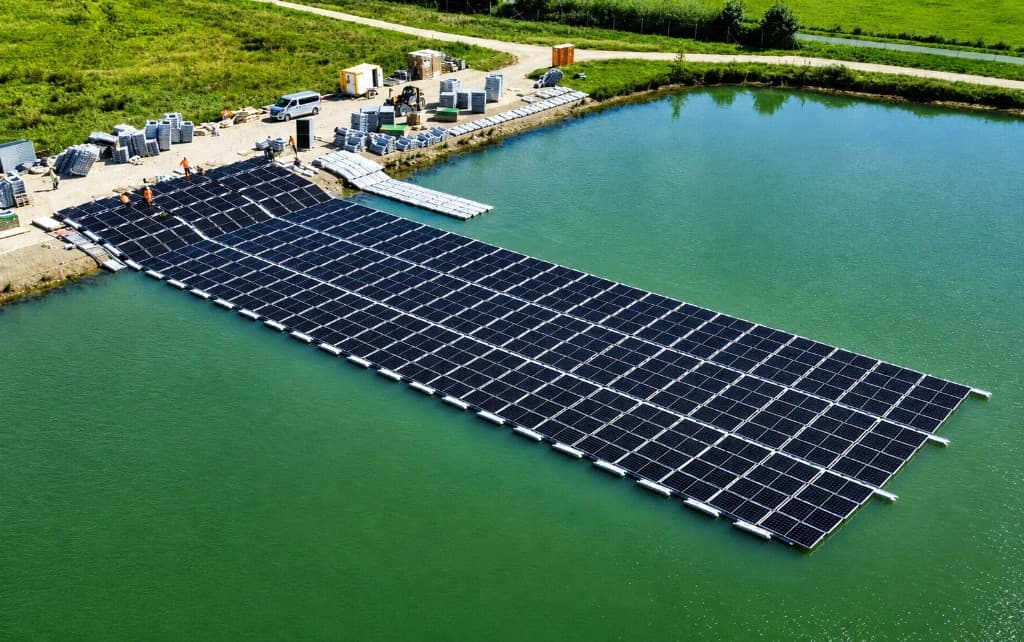
India has just opened a new front in its renewable build-out - and this one does not need a single acre of land. On 31 July 2026, the Union Cabinet approved the Pradhan Mantri Surya Sarovar Yojana (PM-SSY), a ₹5,070 crore Central Sector Scheme to develop 5,000 MW of floating solar photovoltaic (FSPV) capacity with co-located storage across India's reservoirs, dams, lakes and industrial ponds.
For a sector that has spent a decade fighting land acquisition delays, that is a structural shift. Here is what the scheme contains, who gains, and what to do about it.
PM Surya Sarovar Yojana at a glance
| Parameter | Details |
|---|---|
| Scheme type | Central Sector Scheme, Ministry of New and Renewable Energy |
| Total outlay | ₹5,070 crore |
| Capacity target | 5,000 MW floating solar photovoltaic (FSPV) |
| Storage mandate | Co-located energy storage, minimum 2 hours - 10,000 MWh in aggregate |
| Sanction window | FY 2026-27 to FY 2030-31 |
| Disbursement window | Up to FY 2032-33 |
| Central Financial Assistance | ₹1 crore per MW, released post-commissioning |
| Feasibility support | Up to ₹50 lakh per project for surveys and studies |
| Coverage | All States and Union Territories |
| Expected CO₂ reduction | ~10 million tonnes per year |
| Expected employment | 16,000-17,000 full-time equivalent jobs |
Why floating solar, and why now
The National Institute of Solar Energy has assessed India's floating solar potential at 102.18 GWp. Installed floating capacity today is roughly 700 MW. PM-SSY takes that to about 5,700 MW - still under 6% of the assessed potential, which tells you this is a first tranche, not a ceiling.
The logic is straightforward. A 100 MW ground mounted solar EPC project needs roughly 400-500 acres of contiguous, title-clear land, and securing it is routinely the single largest schedule risk on a utility-scale project. Water bodies already owned by irrigation departments, thermal stations and municipal bodies sidestep that problem entirely.
There are engineering upsides too: water cooling lifts module performance a few percentage points, and panel shading reduces reservoir evaporation. Crucially, FSPV does not compete with agriculture - the debate that continues to shape how India approaches a solar power plant on agricultural land.
The economics: what ₹5,070 crore actually buys
Support flows through two instruments, and the second is the more interesting of the pair.
- ₹1 crore per MW, post-commissioning. A performance-linked capital subsidy, not an upfront grant - build risk stays with the developer, and the CFA compresses payback once the asset is live.
- Up to ₹50 lakh per project for feasibility studies. Covering bathymetry and hydrography surveys, environmental assessment and the preparatory work that de-risks a site before capital is committed.
That second line item is worth reading carefully. Floating solar costs roughly 25% more per MW than ground-mounted equivalents - floatation systems, anchoring design and waterproofed balance-of-plant all add cost. The government is funding the front-end study work because badly characterised sites are where FSPV projects fail. Water depth variation, seasonal drawdown, sediment load and anchor-holding capacity are not variables you discover during construction.
That makes the pre-investment study the highest-leverage decision on the project. An experienced Design & Engineering team - one that can turn hydrographic data into a bankable yield model and a defensible anchoring design - determines whether that ₹50 lakh produces a document that gets financed, or one that gets re-done.
Who this scheme is for
- State gencos and discoms sitting on hydro reservoirs and irrigation dams that currently earn no solar revenue.
- Central and state PSUs with captive water bodies - thermal plant ash ponds and cooling reservoirs are among the most technically suitable FSPV sites in India.
- Independent power producers who can win reservoir tenders and monetise the CFA alongside a long-term solar PPA.
- Industrial and municipal bodies with process ponds, effluent reservoirs and treatment lagoons.
- Component manufacturers of floats, anchoring hardware, modules and batteries - all of which the scheme is designed to pull into domestic production.
India's benchmark remains the 278 MW Omkareshwar park on the Narmada, planned to expand toward 600 MW. Globally, floating solar crossed roughly 9.6 GW in 2024 with Asia holding close to 90% of it - proven at scale, not experimental.
What to do in the next two quarters
- Shortlist water bodies. Grid proximity, not water area, is usually the binding constraint.
- Establish who controls the water surface. Irrigation department, state genco, municipal body or private owner - the leasing pathway, and your timeline, differ materially in each case.
- Commission the technical study early. Bathymetry, seasonal drawdown, sediment and water chemistry, anchoring geotechnics. The scheme funds up to ₹50 lakh of it.
- Size the storage properly. Two hours is a floor, not a design target. Where the state has time-of-day tariffs, larger storage often improves returns.
- Model returns with the CFA layered in. ₹1 crore per MW moves the IRR meaningfully - but only if your commissioning date is realistic.
- Fix your execution model before you bid. FSPV blends marine engineering, electrical design and civil works.
On that last point, a Global EPC-M service model tends to fit floating solar better than lump-sum turnkey EPC, because the technology is young enough that design freeze happens late and scope moves. EPCM keeps procurement transparent and design control with the owner, instead of pricing uncertainty into a fixed contract you cannot unpick later.
The bigger picture
PM-SSY joins PM Surya Ghar on rooftops and PM-KUSUM on farmland as the third pillar of India's land-light solar strategy - roofs, field margins, and now water. India is running out of easy land, and policy is adapting faster than most observers expected. For developers, a genuinely new asset class just became bankable, and first movers will have their pick of the best sites.
Evaluating a floating solar project under PM-SSY?
SLNKO Energy is an engineering-led EPCM company with over 10 GW+ of solar capacity delivered across 19 states, backed by a core team from IITs, NITs and IIMs. We support projects end to end - Design & Engineering, Global EPC-M execution, Public Sector PMC and long-term O&M.
Talk to our team about your PM-SSY project. Share your site details and we will come back with an indicative feasibility view - Start your project.
Estimate returns first with the SLNKO ROI Calculator, or view our portfolio.
Phone: +91 62025 28672 | WhatsApp: +91 87962 60069 | Email: Contact us
Office: B-26, Block B, Sector 6, Noida, Uttar Pradesh 201301
Frequently Asked Questions
What is the PM Surya Sarovar Yojana?⌃
PM Surya Sarovar Yojana (PM-SSY) is a Central Sector Scheme approved by the Union Cabinet in July 2026 with an outlay of ₹5,070 crore, to develop 5,000 MW of floating solar photovoltaic capacity with co-located energy storage systems across India's inland water bodies.
How much subsidy does PM Surya Sarovar Yojana provide?⌃
The scheme provides Central Financial Assistance of ₹1 crore per MW, released after successful commissioning, plus up to ₹50 lakh per project to fund feasibility studies including bathymetry, hydrography and environmental assessments.
Who is eligible under PM Surya Sarovar Yojana?⌃
The scheme is open across all States and Union Territories. State generation companies, discoms, central and state PSUs, independent power producers, and industrial or municipal bodies with suitable water bodies can develop projects under it. Detailed eligibility should be confirmed against MNRE scheme guidelines once published.
Why does PM-SSY mandate energy storage?⌃
Projects must include co-located storage of at least two hours, totalling 10,000 MWh across the scheme. This smooths solar intermittency, supports evening peak demand and reduces the grid-balancing burden that large solar additions otherwise create.
Is floating solar more expensive than ground-mounted solar?⌃
Yes - around 25% more per MW, because of floatation platforms, anchoring systems and waterproofed electrical infrastructure. That premium is partly offset by the ₹1 crore per MW CFA, the absence of land acquisition cost and delay, and a modest yield gain from water cooling.
How long will PM Surya Sarovar Yojana run?⌃
Projects will be sanctioned between FY 2026-27 and FY 2030-31, with financial assistance disbursed up to FY 2032-33.
Sources: Press Information Bureau, Government of India; Ministry of New and Renewable Energy; National Institute of Solar Energy. Figures current as of 4 August 2026.